Science applications and workflows, from proposal to cruise report

MFP runs the whole process a ship-time, equipment or facility application goes through: the form, the reviews, the decision, the planning steps, the permits and the post-cruise assessment. Each institute configures its own stages, roles and forms. No custom development.

One workflow engine, your stages, your roles

Research institutes on five continents run their ship-time, equipment and proposal workflows on MFP, each with its own forms and its own approval chain.

Create Application from a dedicated portal
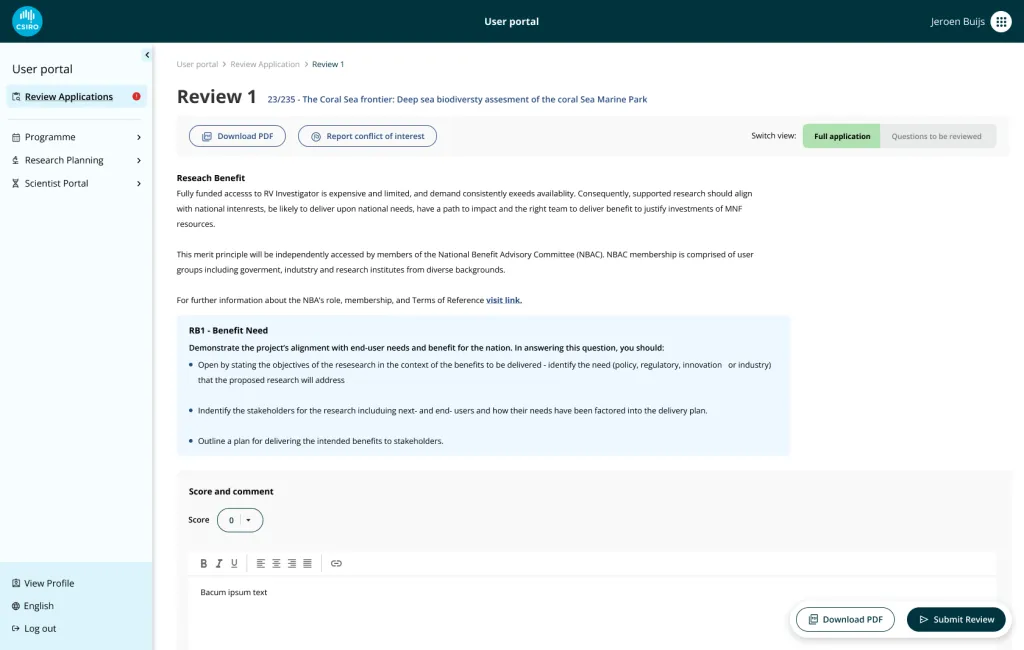
Integrated Review Process
Manage Applications & Opportunities
Application Form - Platform & Equipment Selection
Application Form - Project Information
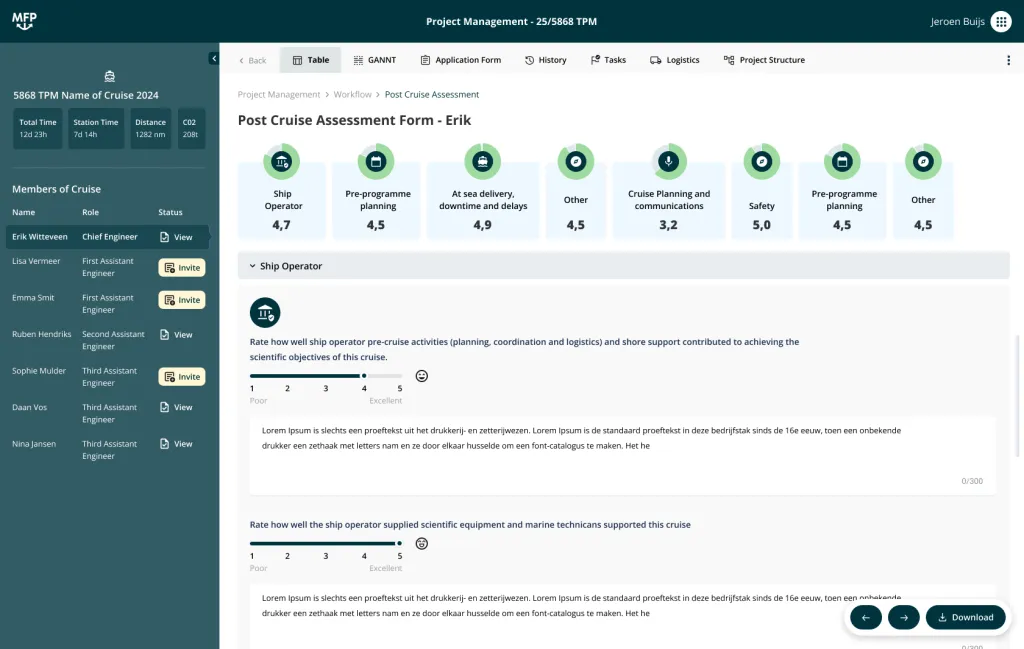
Post Project - Assessment Form
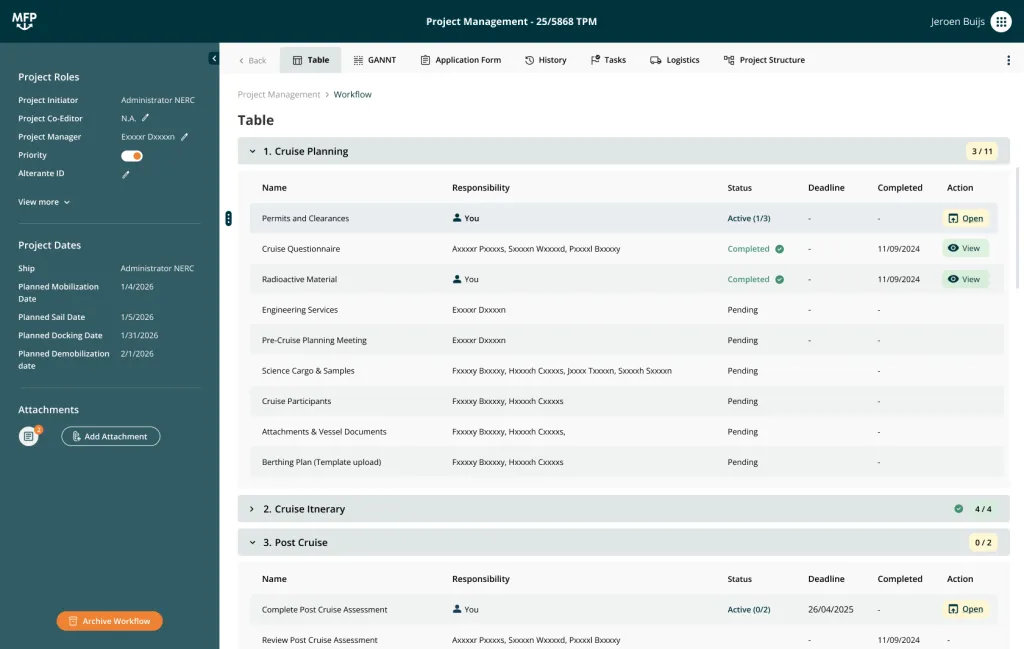
Workflow - Process Management

What you can do with it

From the first form to the closed project, every step has an owner, a status and a record.

Application forms per workflow

Scientist information, funding, cruise location drawn on a map, dates, ship selection, fitted and pool equipment, hazardous materials, environmental impact. Your institute decides which steps exist and which fields are mandatory.

Stages, steps and roles

A workflow is a sequence of stages from application to post-cruise. Every step is owned by a role: PI, chief scientist, project manager, planning officer, engineering, logistics. Finishing one step activates the next.

Reviews and approvals

Engineering reviews, funding confirmation, approval gates, offers to accept, supply agreements and costs to sign off. Each with its report, its decision and its timestamp.

Into the programme in one move

An approved application is added to the programme and the schedule from the workflow itself. Ports, dates and contingency days flow straight into Schedule Construction.

Permits and clearances

Diplomatic clearance, marine protected areas, marine notices and other permits per country, with templates, status and documents. When clearance is not needed, the follow-up step closes itself.

Science party and cabins

Invite participants from the workflow, collect their details through onboarding forms, and allocate cabins per ship with a drag-and-drop planner.

Equipment and platform questions

Ask about fitted, pool and user-supplied equipment, platforms and specialised requirements, and pass the answers to the research planner and the technicians.

Post-cruise assessment and reports

Questionnaires, scores and dashboards per cruise, cruise reports and data submission confirmations, so a project closes with evidence.

Built from real processes, not a generic form builder

The ship-time and marine equipment workflow of a national facility has six stages and close to forty steps, each owned by a named role. MFP runs it. It also runs the two-step monitoring application of a Swedish survey vessel, and a drilling proposal with site tables, on the same engine. Templates are edited by the institute, not by us.

A portal scientists actually use

Applicants start in the Scientist Portal: pick the workflow, work through the steps, draw the research area on the map, add map snapshots to the summary and submit. They see where their application stands, who holds it and what is still needed from them, without e-mailing the office.

Reviews with a trail

Reviewers get the application report, record their assessment and finish the step. Approvals, offers, supply agreements and costs are logged with who did what and when. The workflow history is visible to everyone with view access, and the role scheduler shows who is responsible next.

Closed with evidence

After the cruise the PI completes the post-cruise assessment, the office publishes it, reports and data submissions are confirmed and the project is closed. Dashboards compare assessments across cruises and years.

CSIRO Marine National Facility, AustraliaFAAM Airborne Laboratory, United KingdomOceanXU.S. National Science Foundation (NSF)United States Coast Guard (USCG)Finnish Environment Institute (Syke)International Ocean Drilling Programme (IODP³)Institute of Marine Research (Havforskningsinstituttet), NorwayGEOMAR Helmholtz Centre for Ocean Research KielMarine Institute, IrelandNOAA Office of Marine and Aviation OperationsFederal Institute for Geosciences and Natural Resources (BGR), GermanySouthern Coastal Research Vessel Fleet (SARDI), South Australia
Environment Agency – Abu Dhabi (EAD)Spanish National Research Council (CSIC)Japan Agency for Marine-Earth Science and Technology (JAMSTEC)King Abdullah University of Science and Technology (KAUST)REV Ocean, NorwayEnvironment Agency – Abu Dhabi (EAD)Natural Environment Research Council (NERC), UK Research and InnovationFlanders Marine Institute (VLIZ)Schmidt Ocean InstituteUniversity of Gothenburg, SwedenVoice of the Ocean Foundation (VOTO), SwedenSWERVE, Swedish Research Vessel Infrastructure for Marine ResearchRoyal Netherlands Institute for Sea Research (NIOZ)

Why choose us?

Trusted by leading research institutions worldwide

Royal Netherlands Institute for Sea Research (NIOZ)
“MFP enabled NIOZ precise coordination of people, equipment movement, and research activities in line with ship operations, with efficient use of resources across marine projects.”

Dr. Zeynep Erdem, NMF Science Coordinator NIOZ
National Oceanography Centre
“The MFP gives NOC a single, live picture of the marine programme so decisions are made with the whole picture in view: science goals together with equipment, personnel and operational requirements are all in one place. MAAS understand how research ship operations actually work. The MFP was shaped with our planners rather than imposed on them, and it shows in how readily the teams have adopted it.”
Dr Eleanor Darlington, Deputy Director of Research Infrastructure, National Oceanography Centre

See your own workflow in MFP

Send us the application form you use today. We show it running in MFP, with your stages and your roles, in a demo.